
How To Be A Successful Failure
Five failure-filled steps to surviving a creative career (and maybe life in general)

How To Be A Successful Failure in Five Easy (Just Kidding! Actually Hard!) Steps
“Ever tried. Ever failed. No matter. Try again. Fail again. Fail better.” - Samuel Beckett
Y’all, I have failed.
Just a few days ago, I received a rejection for something I’d really, really wanted. It knocked me on my butt. However, instead of wallowing for a week or even a full day, I dusted myself off and resolutely added this to my long list of failures. I have lost out on things I wanted hundreds, nay, thousands of times.
I am—not to brag—a failure expert.
Need to know something about rejection, losing, getting ghosted, pivoting due not to choice but because it’s your only option? I got you, babe. That’s right: I’m your go-to Fail Gal!
“But Beth!” Some might cry, alarmed at this downer of a declaration. “You’re a USA Today™ bestselling author! You’re a produced-playwright! You’re not a failure!”
“Ah, my darlings,” I’d reply (in this lofty conversation of my own imagining). “I appreciate your kind defense of my honor. But the truth is, I am a failure, many times over. The real trick is, I’m a successful failure.”
If you’re now wondering what the hell I mean by successful failure, and how one might achieve such a designation… good, the intro section of this essay did as intended. So let’s get down to it, shall we?
Step One: Define Successful Failure (It’s Personal)
Successfully failing can mean other people assuming you’re doing quite well when you feel you’re Very Much Not. It can lead you to want to hide your failures, lest your true loser-status be revealed. It can definitely amp up your imposter syndrome. In other words, it’s this dark, undefined, messy state of being. So let’s define it. Drag it into the sunshine. De-clutter and de-stigmatize it a little.
I define successful failure as failing repeatedly at something you love while managing to still love it, still pursue it, and steadily convince others (and hopefully yourself) that this really is An Important Thing you will keep doing.
For me, as a writer, being a successful failure means consistent writing, frequent rejection, occasional success… but even when I’m failing and flailing, sticking with it. Doing it for so long that people believe I’m still a writer even when time between successes yawns like an endless abyss.
YMMV with the exact definition, but the same can be said of success itself: it looks like different things to different people. If you’re an actor, an artist, an architect*, whatever— there are parallels in the process of chasing your goals, but you can set your own specific parameters for what successful failure looks like for you.
*If you are an architect or a doctor or something, please set parameters wherein failure is only defined as losing out on a job or not being selected for a fellowship, and not, you know, failing building safety inspections or failing to remove the correct kidney.
Step Two: Fail Frequently
Self explanatory. See the Beckett quote that kicked this post off.
You can’t be a failure—or a success—without putting yourself and/or your work out there, a lot. In case you need another quote, here’s a banger from Tina Fey: "You've got to experience failure to understand that you can survive it."
Step Three: Terrible Timing
I am the queen of terrible timing. (But let’s not make this all about me: we live in an era of terrible timing.) I think the key is to learn to laugh anxiously at the reality of terrible timing, roll with it as best you can, and be ready for the universe to send unexpected alternative options your way.
To wit, let me explain in a nutshell what my last decade of successful failure as a writer looked like. Please feel free to groan along with me:
In 2016, I sold the YA dystopian trilogy I’d written in my twenties to an indie publisher. A three-book-deal! Success! But soon after the first book in the series came out, the owner/publisher was hospitalized for mental health issues (which they wrote about publicly; thankfully, they’re healthier now). The second two books were published, but with no publicity... and soon after, the imprint folded.
But! In 2017 I won a big play contest, and decided to keep focusing on theater!
In 2019, after more than a decade of hustling as a playwright, my play Hazardous Materials premiered at Creede Repertory Theatre to critical and audience acclaim. The process was joyful. It won the Henry Award for Best New Play or Musical. It had six regional premieres lined up… for the 2020-2021 season. In March of 2020, all theaters went dark. I lost all my contracts. I was bummed.. and in lockdown.
But! After years of querying— 2020 was also when I signed with a literary agent.
In early 2023, my agent sold I Made It Out Of Clay. To a Big Five publisher. At auction. We expected great things. But the book’s release was pushed to mid-December 2024, and in the interim between writing the book in 2022 and its debut, a lot happened. Most of it bad. I unexpectedly lost my dad, which shattered my personal life. Global events shifted the social and literary landscape. When my book came out, it did well initially (thanks to everyone who bought it, especially pre-order fairies!). But it didn’t hit the publisher’s sales goal. They dropped my second-book option. I was crushed. Since 2023, I’ve completed three (and a half!) novels, all of which are—no offense to, uh, me—objectively better than Clay. Yet I have no next book deal.
BUT! SOMEHOW WITHOUT TRYING I HAVE TWO WORLD PREMIERE PRODUCTIONS HAPPENING WITHIN THE NEXT YEAR AND I AM, ONCE MORE, A PLAYWRIGHT. (Yes. My next post will share this wild story.)
I’d say that based on this pattern, my productions will tank but then HEY MAYBE I’ll get a new book deal… but let’s be real. I know nothing about how success or timing really works. I only know how to keep going. (Sometimes only after briefly cursing the world and considering quitting it all. I’m not a robot, babes. Just stubborn.) Maybe the shows will be great, and I’ll get that next book deal. Or maybe I’ll be offered a gig penning lyrics for a girl band, and that’ll be the next adventure.
Step Four: Spin Those Plates, Baby
As evidenced in my overly-long step three above… having lots of spinning plates is often essential to successfully failing. I never have just one project on the docket, and always have several in my back pocket. My advice? Be open to pivoting to another project when unexpected opportunities arise.
Step Five: Cheer ‘Em On (And Scream Into Your Pillow)
It is so hard not to get jealous when you’re failing while watching peers succeed. But when I’m listening to my better angels, I know as competitive as creative fields are, other artists aren’t the enemies. Ideally, in the long run the success of any writer helps every writer. More lifelong readers = more people buying books. The real enemies are low readership, and broken systems in publishing and everywhere else, and AI (this too will be another post soon), and a thousand things that aren’t other writers.
So cheer for your peers, loudly, publicly. It’s the right thing to do. And, I promise you, it won’t make you look like more of a failure—it will make you look like less of one. (You can also scream into your pillow/rant to your partner/tell your dog all about how you really feel in the privacy of your own home. I have done all of those things. Not all of my angels are better; some are bitter.) Your next success will feel even better when you’ve built up a mutually-encouraging community. Besides, maybe your rockstar peers look successful but are also reeling from their own failures. You never know.
More of us are successful failures than you think.
Whatever you’re attempting this week, I hope you succeed spectacularly— or fail in a way so wild, so hilarious, so unique, that you trip your way into the next door you’re meant to walk through. ~
What’s On My Bedside Table (Or In My Earphones): Famesick by Lena Dunham
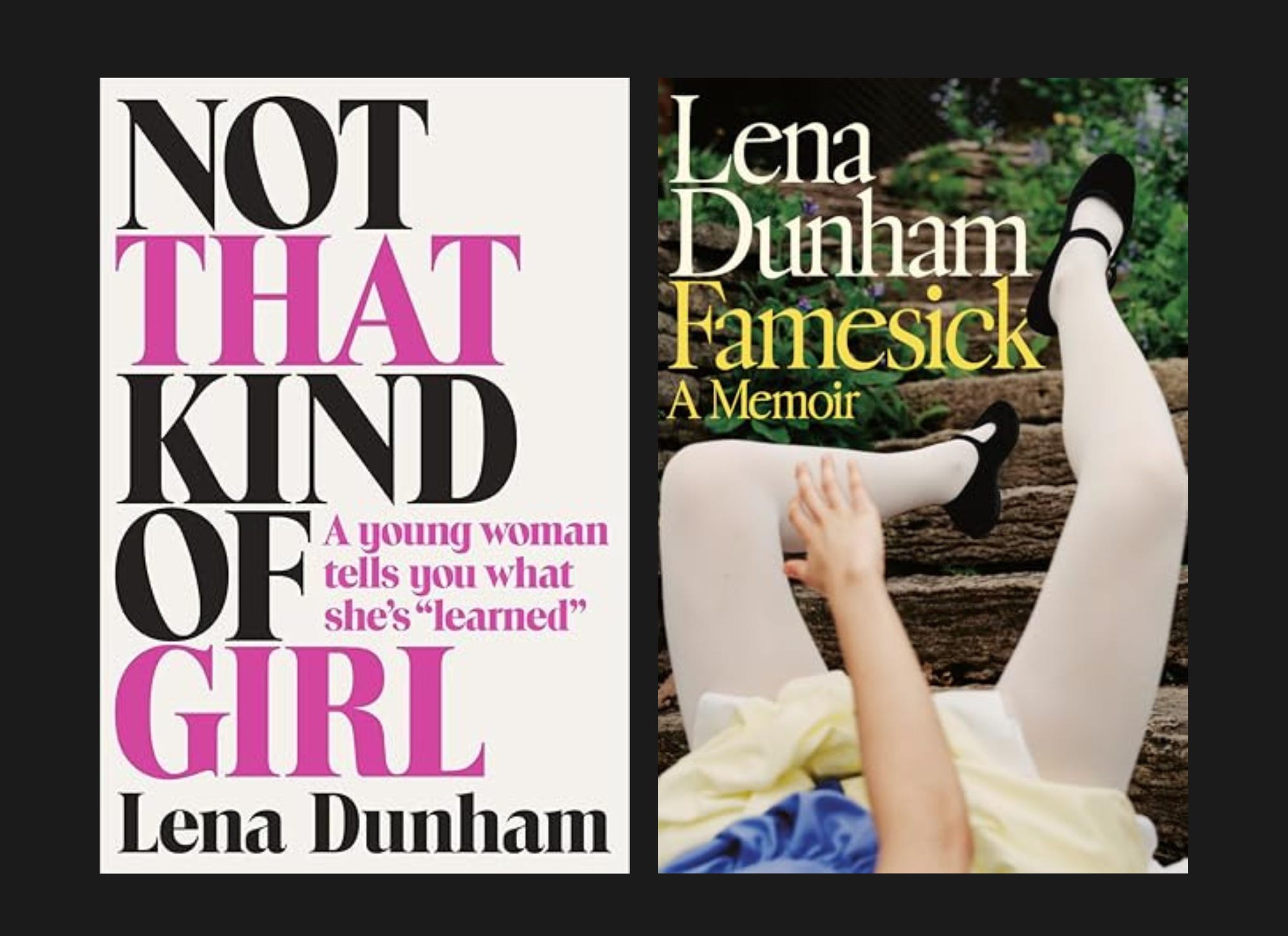
Wow, y’all. I didn’t plan this, but: if I am a successful failure… Lena Dunham’s new memoir paints her as a failed success.
Famesick is frank, vulnerable, sometimes scathing, often unsettling— but we’ll get to all that in a minute, because it’s not where I started this reading journey. As the image above indicates, I recently read TWO Lena Dunham memoirs, which was definitely not on my 2026 Bingo card. Famesick is super buzzy, so I put a hold on it at my library (adhering to a rule designed to keep me out of bankruptcy: I buy the book if the author is a friend/emerging/actually benefits from my purchase; otherwise I go to the library). While waiting, I decided to read Lena Dunham’s first biography, written and published at the age of twenty-six, while still in the midst of filming the series Girls.
I was not a Girls fan. Nothing against it, I was just too broke to have HBO when the show came out. So her first memoir, Not That Kind of Girl, wasn’t on my radar when it debuted. (Nor was Dunham herself, except for the fact that she was in my brother’s class at Oberlin. They didn’t hang.) I listened to Not That Kind of Girl as I drove around Los Angeles last week; fitting, since it holds a lot of LA moments. Conveniently, the day I finished this memoir, the library alerted me that Famesick was available.
Reading these two memoirs back to back was, in all sincerity, fascinating. The one written in her twenties, at the height of her fame, is brash, unapologetic, occasionally vulnerable, but mostly in-your-face and full of gleeful oversharing. There are hints of something darker beneath the surface, but the surface is very much where the book remains—even with all the overt TMI anecdotes.
Famesick tells a different story. The dark undertones take center stage as Dunham writes about everything from her meteoric rise to fame to chronic illness to wild expectations put on a girl barely out of college to backstabbing collaborators and reminders of how brutal the public can be. I remember that last part, even as a non-follower: Lena Dunham became the name associated with the self-involved millennial. That’s not easy.
There’s a a self-assurance in Famesick that is absent in Not That Kind of Girl. There’s also a lot of blunt curtain pull-back on how “the industry” works. It demands that we all wonder what it would have been like for us, suddenly rich and famous at twenty-six. Would I, too, have battled addiction, felt betrayed or belittled by almost everyone in my life, and become a societal punching bag? Maybe it’s better to achieve success later in life. In my forties, if fame ever comes, I’ll be grounded enough to handle it. (Tbh while I want my writing to be my legacy, I have little interest in high-profile fame. But I promise I’d be a great steward of fortune.)
The inherent hypocrisy of Famesick is hard to sidestep. The whole premise, built right into the title and emphasized throughout, is that the intersection of fame and illness caused Dunham tremendous physical and emotional pain. It’s a warning. Dunham even dedicates the book to a long list of celebrities who did not survive their own “famesickness”— Robin Williams, Janis Joplin, Heath Ledger, etc. In recent years, Dunham was off all social media, lowered her profile, appeared to be heeding her own advice. But this tell-all rocketed her immediately to the #1 spot on the New York Times and every other literary list out there. The spotlight is once again pointed at her.
It’s also hard to gauge how reliable a narrator Dunham is, which she readily admits. Maybe it was them, maybe it was me, we were probably all to blame characterizes a lot of the memoir’s reflections. Plenty of folks come out looking pretty bad (Adam Driver is likely punching through a wall as we speak, if this book is to be believed and if he deigned to read it). There’s some eyebrow-raising moments. But if you’re looking for a memoir that doesn’t flinch from personal mistakes, trauma, and drama, give Famesick a read. Dunham’s a good writer, and I found myself rooting for her finding her way to a more clear-eyed understanding of herself, her health, and the nature of fame.
Lagniappe: What I’m Writing Now (And Why I Wasn’t Writing)
I know, friends. I already wrote so much in the first two sections of this post. If you need a break, I get it. Stretch, hydrate, have a little nosh. But then, if you still want more… I’m going to share a little bit of what I’m actually creatively-writing these days.
And also why I wasn’t writing…
Here’s where the paywall begins!
Keep reading with a 7-day free trial
Subscribe to Beth Sentences to keep reading this post and get 7 days of free access to the full post archives.